
Full article
Full article text extracted for easier reading in-app.
Colorado housing market faces falling buyer demand as mortgage rates hit two-year high
Fewer Colorado homes are selling, and those that do are taking longer to move — a trend that could deepen as mortgage rates climb above 7%, adding to affordability concerns for would-be buyers. The average interest rate on a 30-year fixed mortgage rose to 7.09% on Friday, Sept. 18, climbing to its highest point in…
Andrea Teres-Martinez · PostIndependent.com
Fewer Colorado homes are selling, and those that do are taking longer to move — a trend that could deepen as mortgage rates climb above 7%, adding to affordability concerns for would-be buyers.
The average interest rate on a 30-year fixed mortgage rose to 7.09% on Friday, Sept. 18, climbing to its highest point in at least a year and a half, according to Bankrate.
“It is definitely a psychological number for buyers and sellers, and people looking for mortgages to refinance,” said Bob Casals, broker-owner with Casals Financial Inc. based in Grand County. “It’s a scary number.”
The rate hike comes just days after the Federal Reserve increased the federal-funds rate for the first time in three years on Sept. 16, citing elevated inflation in their reasoning. Increases to the benchmark rate, though not directly responsible for raising mortgage rates, can heavily influence home loan costs.
The last time average mortgage rates surpassed 7% was in early 2025, before trending downward toward the middle of the year. Rates hit a three-year low in February 2026 when they dipped below 6%, and soon after they resumed their climb throughout most of 2026.
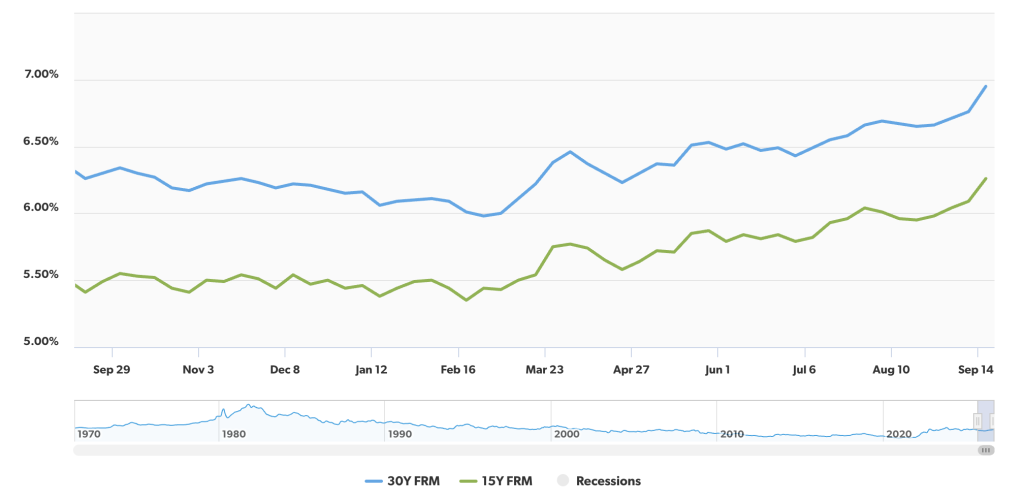
The Federal National Mortgage Association now predicts rates will continue rising into 2027.
Could high mortgage rates reduce demand on the Western Slope?
After February’s low mortgage rates multiplied inquiries from first-time homebuyers — many of whom had been sidelined by affordability concerns for the better part of 2025 — mortgage brokers say spiking rates could have the opposite effect during a time when the market is already seeing fewer sales.
In August, home sales across Colorado fell 11.3% and pending contracts fell 3.7% year over year. These trends were paired with an 8.3% increase in selling times to an average of 65 days on market, according to the August market report from the Colorado Association of Realtors. Despite a 2.4% increase in new listings compared to last year, active inventory fell 6.2% to 34,488 properties.
“Buyers appear to continue saying, ‘We like it… but we’re going to think about it for a while,'” David Ramirez, a Pueblo Realtor, said in the report. “Despite fewer homes being available, buyers aren’t exactly stampeding through the front door. So, if inventory is shrinking, prices are softening, and homes are taking longer to sell, are … buyers becoming more selective, or are sellers still pricing at yesterday’s market while buyers are shopping in today’s?”
Not all of the waning demand from potential homebuyers is directly tied to rising mortgage rates, however. Matthew Starr, the owner and managing broker of Astralis Real Estate in Rifle, said in an email that seasonal changes are also in play as Colorado transitions out of a summer market. The National Association of Realtor’s research shows that activity typically cools off heading into fall.
“August’s figures cannot yet measure the effect of September’s rate increase,” Starr said.
While lower sales and longer selling periods are attributable to a number of factors, 7% mortgage rates certainly aren’t helping to speed things along, Casals said.
Combined with broader impacts from inflation and rising costs in areas like housing and transportation — with gas prices inching toward $5 across some Western Slope counties — motivation is low for Coloradans looking to buy their first home.
“For illustration, a hypothetical $480,000, 30-year mortgage at 7% costs approximately $316 more per month in principal and interest than the same loan at 6%,” Starr said. “… That comparison excludes taxes, insurance and other ownership expenses. For a household already near its payment limit, the difference can mean considering a less expensive home or postponing a purchase.”
The median age of a first-time homebuyer is at an all-time high, sitting at 40 as of September, according to data from the National Association of Realtors.
Historically, falling sales have meant greater negotiating leverage for buyers and increased pressure on sellers to “price realistically from the outset,” the report states, though buyers facing higher mortgage rates might be more hesitant to act on this advantage — particularly in Western Slope ski towns, where median prices for single-family homes can sometimes be more than double the statewide median.
Nearly half of Summit County’s active listings exceeded $1 million in August, while the statewide median sale price held steady at $550,000. In Pitkin County, the median sales price for a single-family home was $3.6 million in August, followed by $1.9 million in Eagle County, an increase of almost 18% year over year.
Because interest rates can be unpredictable, Casals said it may still be in buyers’ best interest to take the plunge now instead of risking higher interest rates down the line — as experienced by many interested homebuyers who decided to wait for February’s sub-6% rate to drop further. After all, there’s always the option to refinance a home loan if rates drop, he said.
“People thinking, ‘Oh, I’m going to wait for it to go lower,’ they may be wrong again,” he said. “I always say go for it. Don’t wait.”
As far as seller behavior goes, Casals said higher mortgage rates traditionally encourage more concessions, such as rate buy-downs, which temporarily lower payments with the hope of refinancing if and when average interest rates drop.
An owner with a low fixed-rate mortgage, on the other hand, may be more reluctant to sell when mortgage rates are high because financing the next home would be more expensive.
“Higher rates can therefore discourage both buying and selling… not simply push prices downward,” Starr said.
Where do Western Slope buyers have more leverage?
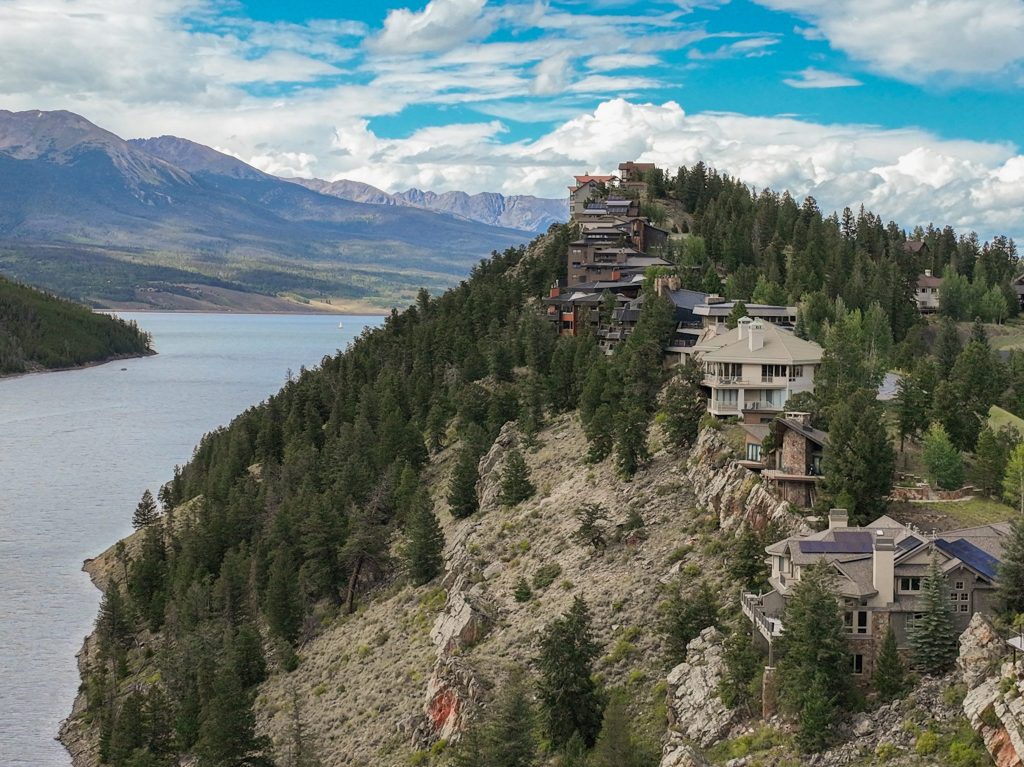
Housing market trends in several Western Slope counties seem to suggest an ongoing shift toward a buyer’s market — though that doesn’t always guarantee improved affordability, according to Starr.
“Buyers can have more negotiating room without having more purchasing power. More choice is not the same thing as improved affordability,” Starr stated in an email.
In Grand County, August’s trends show that buyers are staying active, albeit with more selectivity. Monica Graves, a Grand County-area Realtor, said in the report that inventory remains elevated and buyers have more negotiating power than they did a few years ago, supporting the region’s status as a buyer’s market.
Median single-family home prices were up 31% to just over $1.3 million across the county, while attached homes decreased 12.3% to $515,000.
“The gap between what a seller is asking and where properties are actually selling is important,” Graves wrote. “Earlier summer data also showed roughly 75% of Grand County sales closing below asking price, reinforcing the idea that buyers have regained negotiating leverage.”
Homes in Routt County are also selling, but they’re taking longer, with single-family homes sitting on the market twice as long in August compared to last year. Elevated inventory is also contributing to a longer months supply of homes — a measure of the time it would take to sell every home on the market at the current selling pace — according to the report.
Summit County’s single-family sales rose 18.4% year over year in August, a notable contrast from statewide trends. Multi-family sales declined 4.1%, supporting July’s diverging demand across property types.
Casals said the 7% interest rate on 30-year fixed mortgages typically does more to slow down first-time homebuyers than those looking for investment properties. Because second- and third-home ownership is higher in mountain resort sub-regions of Colorado’s Western Slope compared to other parts of the state, it might not have as noticeable of an impact on actual sales.
“It depends on the buyer. If a buyer is … buying the property as an investment property, that opens up a whole different world of lending,” he said. “[Someone with more investment properties] would definitely hesitate less than a first-time homebuyer or somebody looking to sell their home to buy another home. Investment individuals are banking on gaining value over time, they’re not so concerned about the short term.”