
Full article
Full article text extracted for easier reading in-app.
Mortgage Rates Narrowly Avoid New 52-Week Highs as Bond Yields Surge Higher
It’s been another bad week for mortgage rates. No surprise here. They continue to face upward pressure thanks to a protracted war that shows no signs of
Colin Robertson · The Truth About Mortgage
It’s been another bad week for mortgage rates. No surprise here.
They continue to face upward pressure thanks to a protracted war that shows no signs of abating.
We were promised a swift resolution, and after an ill-fated peace deal, it now seems there’s no light at the end of the tunnel.
As such, oil prices remain elevated and bond yields are now at the highest levels in 52-weeks.
Mortgage rates are just about at their highs as well, and could move even higher if this continues.
10-Year Bond Yields Hit 52-Week Highs as War Goes On
The ongoing conflict in the Middle East has wreaked havoc on the housing market.
Just as mortgage rates hit the lowest levels since mid-2022, a war broke out and it sent them significantly higher.
While there was some hope we’d put it behind us, that ship has sailed (while very few ships sail the Strait of Hormuz).
That sent the bellwether 10-year bond yield to a fresh high today thanks to elevated oil prices and government spending related to the war in the Middle East.
It’s now hovering around 4.75%, which is the highest level seen since the very beginning of 2025.
And now it’s at risk of matching the highs seen in late 2023, when the 10-year was just shy of 5%.
If you recall, that’s when we briefly had those 8% 30-year fixed mortgage rates. But times are different today fortunately.
Spreads Are Helping Keep Mortgage Rates Below 52-Week Highs
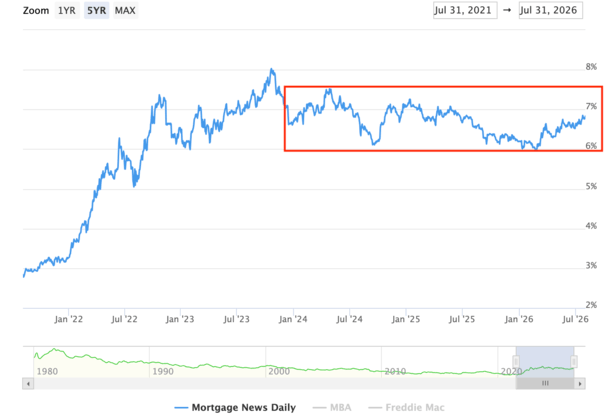
For the moment, tighter mortgage spreads are keeping us below new 52-week highs for the 30-year fixed.
Back in 2023, mortgage spreads widened significantly as the mortgage market struggled in a post-QE world.
Because rates had increased so significantly in such a short span, secondary market liquidity was poor and MBS investors demanded a premium.
Simply put, the 7-8% mortgage rates didn’t seem destined to last and there wasn’t really a market for them yet because rates moved up so quickly.
Today, things are different because mortgage rates have spent a considerable amount of time at, above, or near these levels.
If you look at a mortgage rate chart like the one above from MND, we’ve bounced around these 6-7% levels for a while so there’s an established secondary market.
The prepayment risk is also lower because mortgage rates seem more entrenched and not likely to drop considerably.
That means fewer borrowers will apply for a rate and term refinance, and investors have more certainty that the loans they buy won’t simply get prepaid within months.
To that end, the mortgage rate spread between the 10-year bond yield and 30-year fixed mortgage is now around 200 basis points (bps).
Back in 2023, when the market for 7% mortgage rates was unestablished, it swelled to as high as 325 bps!
That meant a sub-5% 10-year bond yield resulted in near-8% 30-year fixed mortgage rates. Ouch!
Mortgage Rate Spreads Can Only Do So Much
So this explains why the 30-year fixed is still below its 52-week high while 10-year bond yields hit new ones.
Of course, it might not last if bond yields keep rising.
The 30-year fixed, as measured by Mortgage News Daily, hit 6.83% today. It’s 52-week high is 6.85%, reached just last week.
If we get more of the same fighting, escalation, and high oil prices, bond yields could well keep rising.
And it’s not out of the question for them to climb to those levels seen in late 2023 again or even surpass 5%.
If that happens, we’ll definitely have new 52-week highs for the 30-year fixed, but again due to spreads, we’ll stay well below 8%.
That’s why the odds of even a 7%+ 30-year fixed remain pretty low at the moment.
Despite the 30-year fixed averaging 6.66% this week per Freddie Mac, odds of it rising above 7% this year at still at a low 38% chance per Kalshi.
Again, this is because mortgage rates are in an established range today unlike in 2023 when they were only a year removed from being in the 3s.
We’ve been in a fairly tight range for nearly three years now, with the 30-year fixed 6.66% at the end of 2023 and only as high as 7.5% since then.
The low has been around 6%, so we aren’t nearly as volatile as we were in the 2021-2024 era when mortgage rates ranged between 3-8%!
Be grateful.

Before creating this site, I worked as an account executive for a wholesale mortgage lender in Los Angeles. My hands-on experience in the early 2000s inspired me to begin writing about mortgages 20 years ago to help prospective (and existing) home buyers better navigate the home loan process. Follow me on X for hot takes.