
Full article
Full article text extracted for easier reading in-app.
Chase Is Advertising Mortgage Rates With Nearly Two Discount Points to Keep Them Looking Attractive
Was reading about how Chase plans to hire a staggering 850 new Home Lending Advisors when I stumbled upon their mortgage rates page. I check rates from
Colin Robertson · The Truth About Mortgage
Was reading about how Chase plans to hire a staggering 850 new Home Lending Advisors when I stumbled upon their mortgage rates page.
I check rates from big banks and lenders pretty frequently, but was surprised to see their latest offerings.
Instead of displaying rates with a fraction of a point, they’re advertising rates with nearly two discount points required!
For example, a $500,000 loan amount with two points would result in $10,000 in upfront fees.
The idea is you pay more upfront for savings during the life of the loan. But this is unusually high from what I’ve seen in the past.
Big Upfront Points Can Make Mortgage Rates Look Lower
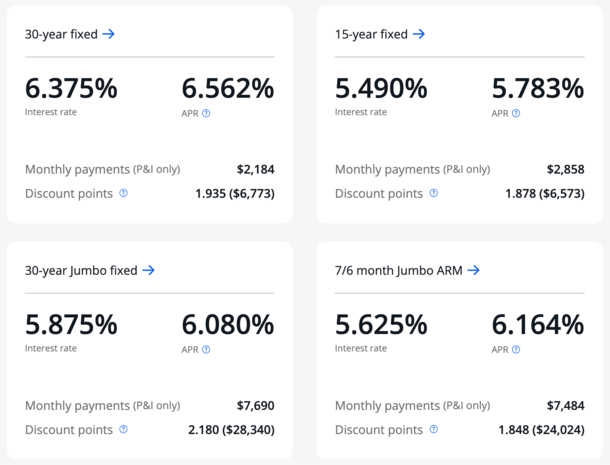
This seems to be a sign of the times. I’ve seen a lot of smaller, online lenders use this tactic after mortgage rates surged higher a few years ago.
But the big banks tend to only advertise rates with some fraction of a mortgage discount point due at closing, such as 0.75%.
It seems Chase is borrowing from that playbook and going with some aggressive point assumptions to display lower-than-market interest rates.
I get it. Times are tough right now and 30-year fixed mortgage rates are nearing 7% again.
This essentially allows lenders to offer below-market rates and keep them looking halfway decent.
However, they require the borrower to pay this prepaid interest at closing to reduce the interest rate during the loan term. And it can get expensive.
For the record, it can make sense if rates are expected to remain elevated or move even higher.
At that point, the borrower who paid a few thousand at closing would perhaps keep the loan long enough to recoup the upfront cost.
But if rates were to come down, maybe due to the conflict with Iran finally coming to an end, it’d be a bad move.
The borrower who paid two mortgage points to snag the 6% 30-year fixed rate wouldn’t be incentivized to give it up.
Even if rates dropped to 5.5%, they’d have to consider eating that big cost if they were to apply for another rate and term refinance.
Do the Math Before You Pay the Points
I recently created a mortgage points calculator to tackle this very issue.
Sometimes it can make sense to pay points upfront, and other times it can be a terrible decision.
Aside from what mortgage rates do after you get your loan, there’s also the matter of tenure.
How long do you plan to stay in the property? If the answer isn’t a very long time, paying points is probably not for you.
If it’s a forever home and mortgage rates likely won’t get better anytime soon (that’s never a guarantee by the way), paying points could be worthwhile.
It might be even more worthwhile if you get the home seller to pay for it via seller concessions. Or the builder to pay for it in the case of a new home.
One last thing though. You should also shop around and see what competing banks and lenders can offer without having to pay points.
Sometimes you can get the low rate (or lowish rate) without having to pay all the points.
The best of both worlds. You just have to put in a little time and perhaps negotiate as well.

Before creating this site, I worked as an account executive for a wholesale mortgage lender in Los Angeles. My hands-on experience in the early 2000s inspired me to begin writing about mortgages 20 years ago to help prospective (and existing) home buyers better navigate the home loan process. Follow me on X for hot takes.